The main Irish wedding traditions are the Claddagh ring, the handfasting (where the phrase “tying the knot” is said to come from), a traditional blessing read aloud, the toast “Sláinte”, a horseshoe carried by the bride for luck, and the “magic hanky” that later becomes a christening bonnet. Most Irish couples use two or three of them, not all six. And at the end of the night, in Ireland, there is nearly always a pub.
I am a bartender from Dublin, and I have worked more weddings than I could count — at home and now here in Massachusetts with The Síbín. What follows is what the traditions actually are, where they come from, and what I have seen work. No invented folklore, no plastic shamrocks.
The Claddagh ring
The Claddagh ring comes from Claddagh, an old fishing village on Galway Bay that is now part of Galway city. The design is a few hundred years old: two hands holding a heart, with a crown sitting on top of it. The hands are friendship, the heart is love, and the crown is loyalty. That is the whole of it, and it is a good deal more than most jewellery manages to say.
How you wear it matters, and this is the part people get wrong:
- Right hand, heart pointing out (towards the fingertips): single, and open to offers.
- Right hand, heart pointing in (towards the wrist): in a relationship.
- Left hand, heart pointing out: engaged.
- Left hand, heart pointing in: married.
So at a wedding, the ring is turned. Some couples do it quietly during the ceremony, some do it as a moment of its own. Traditionally the ring was handed down — mother to daughter, grandmother to granddaughter — and a ring with a few generations on it is worth more to the family than anything bought new. If you have one in the family, ask about it before you buy.
Handfasting — “tying the knot”
Handfasting is Celtic in origin and older than the church wedding. The couple’s hands are bound together with ribbons or cords while they say their vows, and the knot that is left is kept. It was once a form of betrothal in its own right, and it is widely said to be where the phrase “tying the knot” comes from. In fairness, I have never heard anyone argue otherwise.
In practice it is simple. The couple face each other and join hands — usually right to right and left to left, so the arms make a figure of eight. The officiant, or a family member, wraps the ribbons over and around the joined hands while the vows are said. The couple then draw their hands out and the ribbons stay knotted. Three ribbons is common; some use one, some use several in colours that mean something to them. There is no rulebook.
A handfasting is a ceremonial element, not the legal part of the day. The officiant handles the legal bit as they would for any wedding; the handfasting sits inside the ceremony as a ritual. Tell your officiant you want one and they will tell you where it goes.
The blessing and the toast
Every Irish wedding I have worked has had at least one blessing read out, and most have had the same one. It is the one the Irish-American side of the room will know by heart:
May the road rise to meet you, May the wind be always at your back, May the sun shine warm upon your face, The rains fall soft upon your fields, And until we meet again, May God hold you in the palm of His hand.
Give it to someone who can read aloud without rushing. It wants a slow room.
The toast is shorter. Sláinte — pronounced SLAWN-cha, with the stress on the first bit — is the Irish for “health”. You lift the glass, you say it, the room says it back, everybody drinks. That is the entire ceremony. If you want to stretch it, sláinte is táinte (“health and wealth”) is the longer form, but nobody will think less of you for stopping at the first word.
A word from behind the bar: the toast works best when every glass is already full. If you are going to do a round of Sláinte, let the bartenders know five minutes before, and the stout will have time to settle. Nothing kills a toast like forty people waiting on a pint.
The horseshoe
Irish brides have long carried a horseshoe on the day for luck. The one rule is that it is carried open end up, so the luck cannot run out of it. Turn it over and you have poured your luck on the floor, which is not the start anyone wants.
Nowadays the horseshoe is rarely iron. It is usually a small porcelain or fabric one tucked into the bouquet or tied at the wrist, and afterwards it is hung up at home — again, open end up. If a grandmother offers you hers, take it. The ones that have done a few weddings already are the lucky ones.
The magic hanky
This one is quieter and, I think, the loveliest of them. The bride carries a plain linen or lace handkerchief on the day — the “magic hanky”. After the wedding a few stitches turn it into a bonnet, and the couple’s first child wears it at their christening. Years later, the stitches come out and it is a handkerchief again, ready for that child to carry at their own wedding.
So a single square of linen can go bride, baby, bride across two or three generations. It costs almost nothing and it is the thing people are still talking about when the flowers are long gone. If you have one in the family, you already know. If you do not, start one.
A few smaller ones
- Irish music after the meal. Not a playlist — a fiddle, a guitar, a bodhrán, two or three players in a corner. The session standards will have the whole room singing by the second chorus.
- The bells. Guests ring small bells to break up a row between the couple, now or in years to come. A set of bells is a common Irish wedding gift for that reason.
- The child of Prague. A small statue of the infant Jesus of Prague left outside the night before the wedding, for good weather. The head falls off more often than you would think, which is said to be better luck still.
- Mead. The oldest drink in Ireland, sometimes poured for the couple’s toast in a nod to the old “honeymoon” — a month of honey wine after the wedding, or so the story goes.
Where the pub comes in
In Ireland the wedding does not end with the reception; it moves to the pub, and the last of it happens in a snug. A snug is the small private room off the bar where the family end up at one in the morning with the ties off, and it is where the real speeches get made.
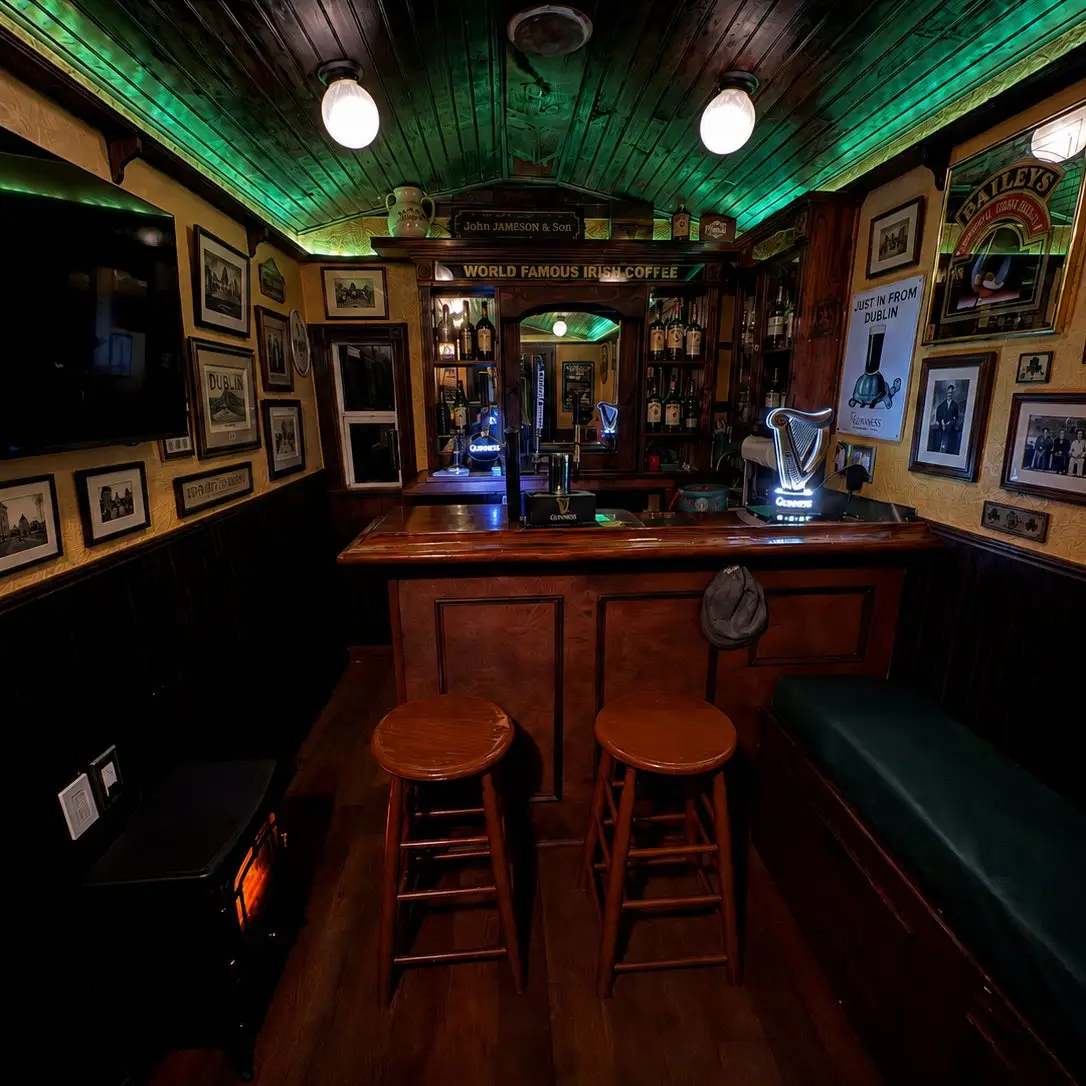
That is the part of an Irish wedding that is hardest to bring to Massachusetts, which is exactly why we rent out The Síbín. It is a towed Victorian Irish pub with a working bar — two draft lines, keg setup and beer gas, coolers and a sink — seating for about sixteen, and a real snug. The walls carry genuine Irish history: Dáil Éireann bonds, a Daniel O’Connell signature and a 1916 Irish Volunteer newspaper. It arrives at your venue or your home, is set up for you, and stays for 24 hours.
How it fits a wedding depends on the day. Some couples put it beside the ceremony for the drinks reception and the first Sláinte. Some have it as the late bar after the band finishes, so the night ends the way it would at home. Some rent it for the welcome drinks the evening before, when the two families meet properly for the first time. Our weddings page walks through all three.
You supply the drink — we never sell alcohol — and you can run the bar yourself or add our bartenders from Ireland, one of whom is a Dubliner, as you may have gathered. The difference between the two is on our staffed vs dry hire page. If it is staffed, we will time the toast for you, keep the Guinness settling, and know what to do when the uncle asks for a hot whiskey at midnight.
The last word
You do not need all of these. Pick the two or three that mean something to the two of you, understand why they are done, and do them properly. Then make sure the glasses are full before anyone says Sláinte.
If you want the pub at the end of it, tell us the date and we will take it from there.