What Is an Irish Pub Snug?
A small private room with its own door and a hatch to the bar — and why ours has one.
The best seat in the house, hidden from it
An Irish pub snug is a small private room or partitioned booth inside a pub, with its own door and a hatch or window through to the bar so drinks can be passed in without anyone passing through. It seats a handful of people, usually just inside the front door, out of sight of the main room. It began in the nineteenth century as a place for people who should not be seen drinking, and it survives because it turned out to be the nicest spot in the pub.
The Síbín, our towed Victorian pub, has a real one — the only mobile Irish pub with a snug we know of in New England. This page is the whole story: where snugs came from, who sat in them, what makes a good one, and why we would not build a pub without it.
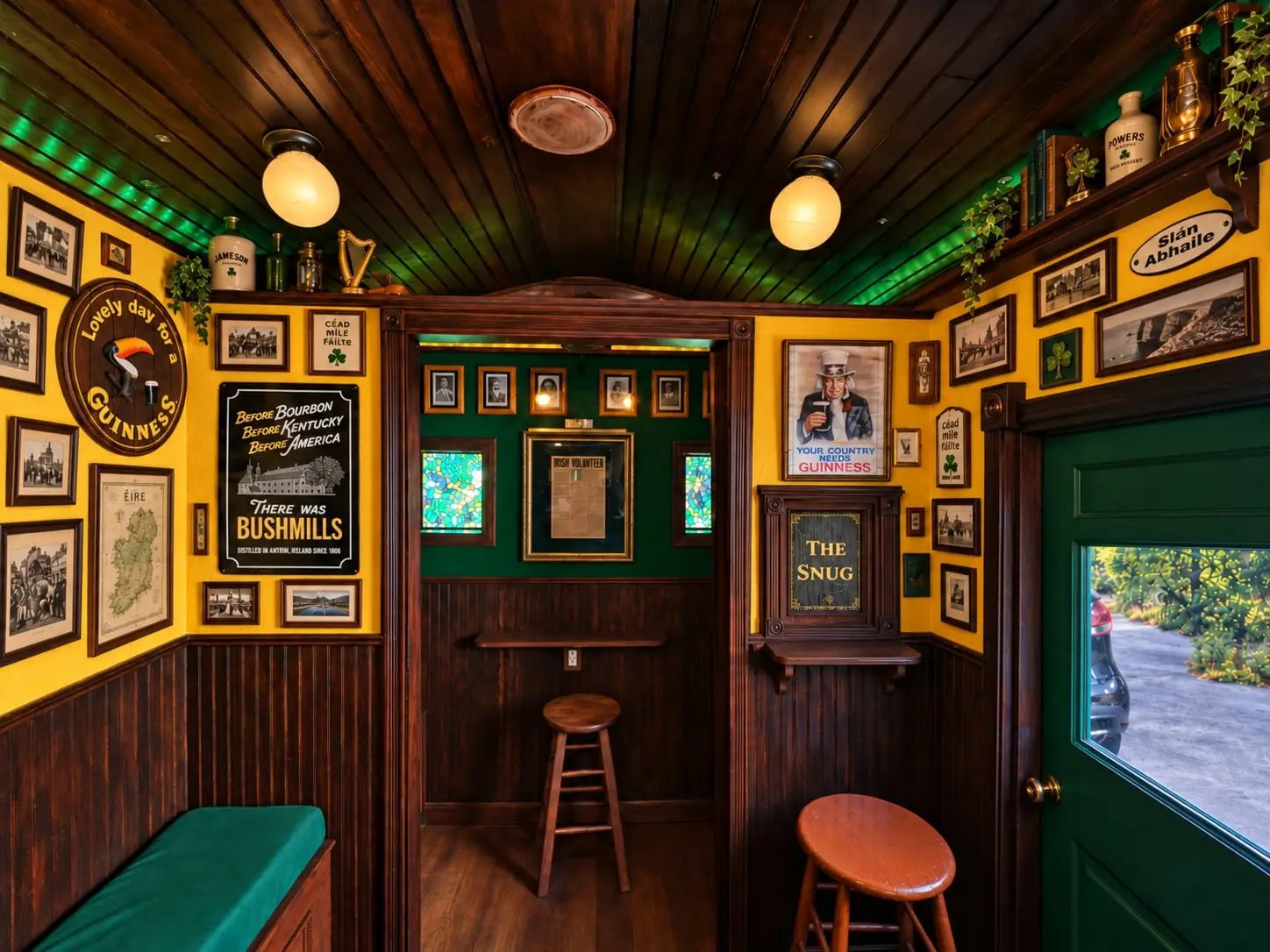 The snug
A short history of the snug
Victorian origins
The pubs of nineteenth-century Britain and Ireland were divided rooms. There was the public bar, with its sawdust and standing room, and off it the smaller, better-finished spaces: the parlour, the saloon or lounge, and — smallest of all — the snug. The name is just the adjective: a snug was a snug little room, panelled, often with frosted or etched glass in the door and the partition so that nobody in the bar could see in. The Victorian taste for dividing people by class and respectability built the snug; the Irish taste for a quiet word kept it.
Who sat in the snug
The public bar was a man’s room, and a respectable woman could not be seen in it. The snug was where she could take a drink — a glass of port, a bottle of stout for her health — without being on view. The parish priest took his whiskey in there for the same reason. So did the local policeman, who was not supposed to be drinking on duty but was, and the sergeant who preferred not to see him do it. Courting couples used it because it was the only place in the parish they could sit together unobserved. And it was the room for business: the price of a heifer, the terms of a match, the settling of a will — conversations that wanted a closed door and a drink on the table.
The hatch
The defining feature is the serving hatch: a small window or sliding panel through to the bar, so the publican could pass in a drink and take the money without the drinker ever showing a face in the main room. In many houses the hatch was the only contact between the snug and the pub. Some publicans charged a little more for drink served there — privacy was a service, and in a crowded pub the snug was the best real estate in the building.
Decline, and survival
The snug nearly vanished in the second half of the twentieth century. Pubs were modernised into open-plan lounges; partitions and panelled booths came down to make room for more drinkers, and the reasons for hiding had faded — women drank openly, and the clergy were thinner on the ground. For a while a snug was a sign that a pub had not kept up. Then the wheel turned. The old Victorian pubs that had been too stubborn or too broke to renovate found their snugs admired, photographed and fought over on a Friday night, and a good snug became the mark of a real pub. Some survive in Dublin and in towns across Ireland and Britain; new pubs, and the better Irish pubs abroad, now build them on purpose.
What makes a good snug
- A door that closes. Half-height partitions are a booth, not a snug. The point is a room.
- A hatch to the bar. Drinks come to you; you do not go to the drinks.
- Small. Four to six people, knees nearly touching. Bigger than that and it is a lounge.
- A bench along the wall and one small table, so everyone faces everyone.
- Near the door. You should be able to slip in and out without crossing the bar.
- Something on the walls. A print, a photograph, a framed page of history — a snug is a room for looking at things while you talk.
- Its own light, lower than the bar’s. Snugs are for the evening.
- Warmth. A stove nearby and no draught from the door. The word is snug, after all.
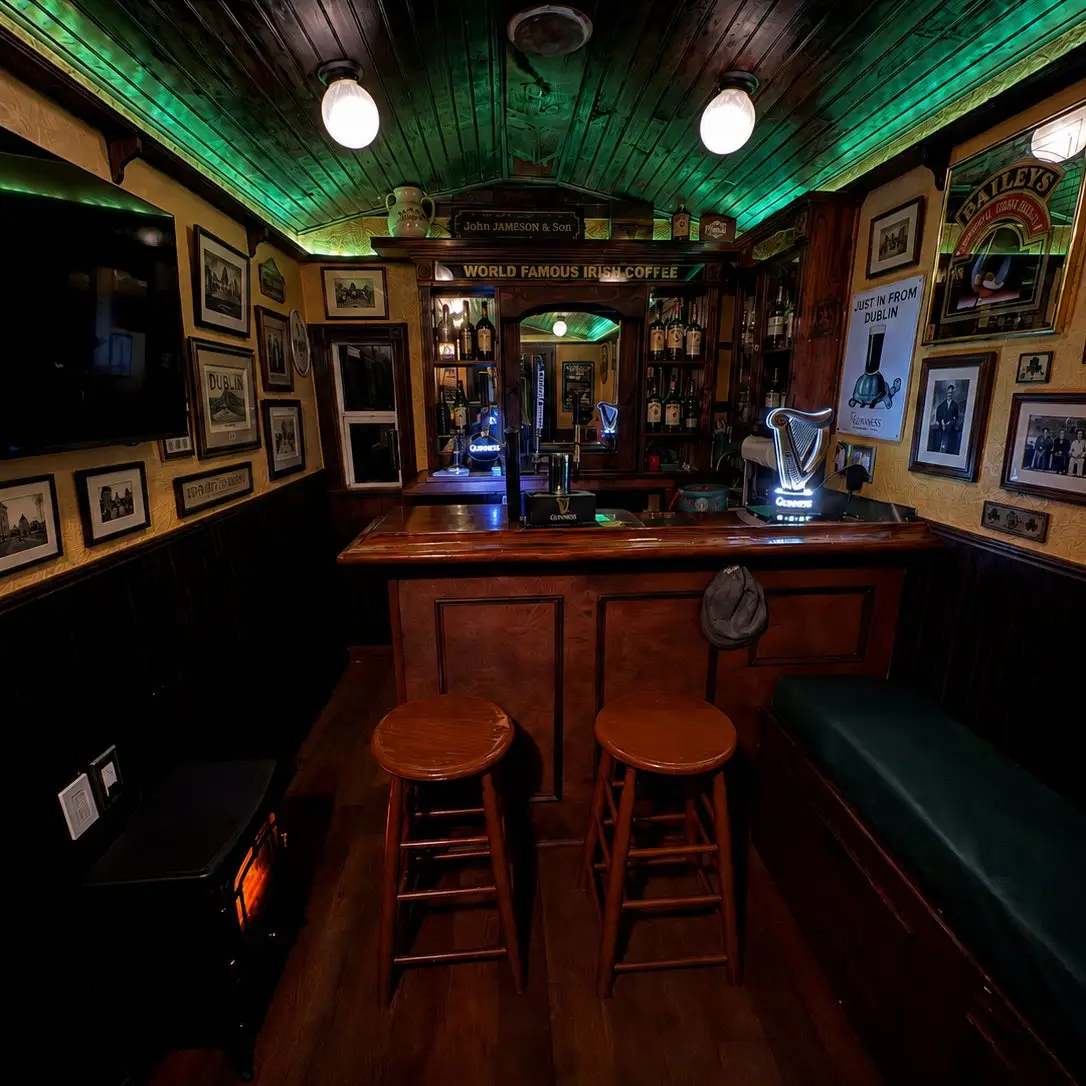 Seats 16
Why ours has one
Because a pub without a snug is a bar. The Síbín is a Victorian Irish pub on a trailer that seats about sixteen, and the snug is the heart of it. It seats part of those sixteen, it has the walls of Irish history you would hope for, and it is the only mobile Irish pub with a snug we know of in New England.
It earns its space at every kind of event. At a wedding it is where the couple disappear for ten minutes with a drink while the room carries on. At a celebration of life it is where the family sit together, part of the gathering and a little apart from it. At a party it is simply where the best conversation is happening. The electric stove heater does the warmth part for us, in fairness.
If you are wondering what the pub is named after, that is a síbín, and we have written that up too. To rent the pub with the snug in it, get in touch.
The only mobile Irish pub with a snug we know of in New England.— towed to your door, for 24 hours
or call (508) 322-1298
Snug questions
What is a snug in an Irish pub?
A snug is a small private room or partitioned booth inside a pub, usually just inside the front door, with its own door and a hatch or window through to the bar. It seats a handful of people out of sight of the main room. Historically it was where anyone who did not want to be seen drinking — women, priests, policemen, courting couples — could take a drink in private.
Why did pubs have snugs?
Privacy, and a little extra money. In the nineteenth century the public bar was a man’s room, and respectable women, clergy and the local constable could not be seen in it; the snug let them drink unseen and be served through the hatch. Publicans in some houses charged a little more for the privilege. The snug was also the room for business — a deal struck, a match made — that was nobody else’s concern.
Why did snugs disappear?
Modernisation. From the middle of the twentieth century pubs were opened out into lounges and the partitions came down; a snug seating six was floor space that could hold twenty. Women no longer needed to hide, and the hatch seemed quaint. Enough Victorian pubs in Dublin and elsewhere kept theirs that the snug is now a prized feature rather than an embarrassment, and a few pubs have built new ones.
Does The Síbín really have a snug?
It does — a proper one, with its own seating, inside a pub that seats about sixteen in all. As far as we can tell, The Síbín is the only mobile Irish pub with a snug we know of in New England. It is the part of the pub that makes it a pub.
How many people fit in The Síbín’s snug?
The snug seats part of the pub’s sixteen; the rest sit at the bar and along the benches. A snug is meant to be close quarters — that is the point of it — so think of it as the corner for the couple, the top table or the family rather than the whole party. Ask us about layouts when you book and we will tell you how we have seen it used.
Is the snug good for a wedding or a celebration of life?
Both, for the same reason: it gives a small group a quiet place inside the party. At a wedding it is where the couple get ten minutes to themselves with a drink. At a celebration of life it is where the family can sit together, close to everyone and apart from them at the same time. Every pub in Ireland has a corner like that; ours comes on a trailer.
Rent The Síbín for your event
A towed Victorian Irish pub with a working bar, a real snug and Irish history on the walls. Tell us the date and where you are.